


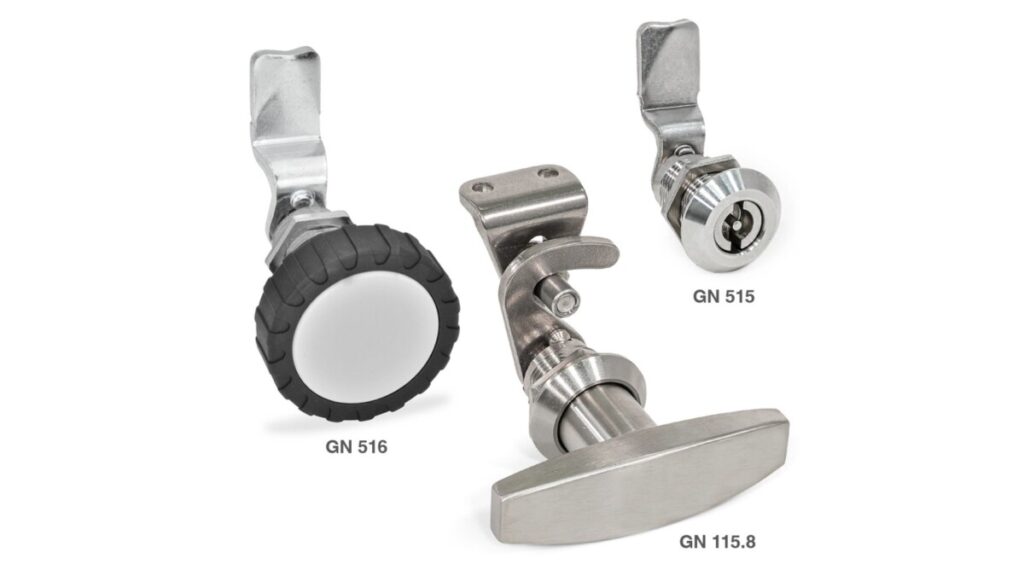

It is a familiar situation for designers: The space available for a closing mechanism is tight, there is no opposing surface for a latch bar or cam latch, but the closing action must be reliable and intuitive. Ganter offers ready-made solutions for such challenges, which can be flexibly adapted to individual requirements.
Hook-type latches, for example. These use a different principle than a classic cam latch. Instead of a latch arm that moves behind a frame, they have a hook that engages with a mating catch by moving radially to the axis of rotation. The GN 115.8 series of hook-type latches has now been expanded – with versions in stainless steel and versions that reliably meet the requirements of protection class IP 69k. When operated with a socket key, the latches can be used even in extremely wet environments. The principle is always the same: When the socket key, bit key, knurled knob, wing knob or lever is turned by 90 degrees, the hook moves along with it. As it can be installed in either orientation, the hook will engage with either a left or right turn, making the latch easy to adapt to any situation. Thanks to its integrated lead-in chamfer, the standard part tolerates a lateral misalignment of up to four millimeters. A practical application example: Hook-type latches positioned to the side are used to lock a horizontal box lid to keep out the weather while dispensing with disruptive framing.
The classic latches with cam latch are still good solutions for applications with latch arm and frame geometry. The chamfered end of the latch arm produces contact pressure when the latch arm is turned by 90 degrees, ensuring tight, reliable closure.
More information on Ganter standard parts can be found on the internet at ganternorm.com