


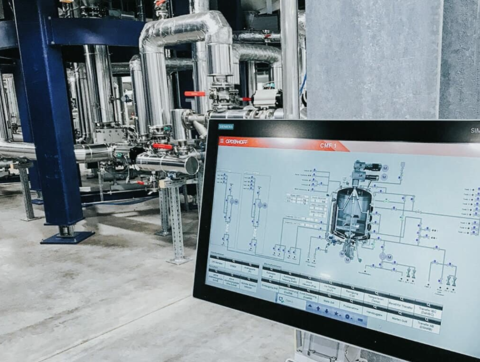
Retrofitting rather than building from scratch: How digital twins make existing plants transparent, efficient and future-proof
Future-proofing today does not come about through new installations at any cost. It comes about through the intelligent further development of existing structures. Particularly in times of limited investment budgets, retrofitting becomes a strategic lever. The digital twin plays a central role in this: it links real-world material flows with process, energy and quality data, and for the first time provides a holistic view of the complex interrelationships in raw material handling – from the individual unit to the entire work.
In practice, it is clear that transparency is not an IT issue, but a leadership issue. Those who understand their processes invest more effectively, reduce downtime and regain decision-making capacity. This is precisely where integrated approaches come into play – from MES systems and digital plant twins to PLC automation, SCADA/control systems and engineering services for brownfield and greenfield projects, as well as modernisation.
Retrofits, in particular, are key to future-proofing existing systems rather than replacing them.
The fact that this approach works is demonstrated by numerous completed projects and independent accolades, such as the rote BSFZ-Siegel of approval for innovation excellence.
The SOLIDS & RECYCLING-TECHNIK Dortmund
SOLIDS Dortmund 2026 is the place where this very reality is discussed: in a practical, honest and peer-to-peer manner.
Just how transparent is your raw materials handling process really?
Where does the digital twin come into play, and what is the cost of continuing to make decisions without it?
The dialogue begins at the trade fair.
For us, a partnership is more than just a contract or the start of a project
Updated on 24 February 2026, Source:
SOLIDS & RECYCLING-TECHNIK Dortmund, Easyfairs Deutschland GmbH
A pair of trade fairs for the bulk materials, process and recycling industries